Landauer House as a hospital physiotherapy gymnasium
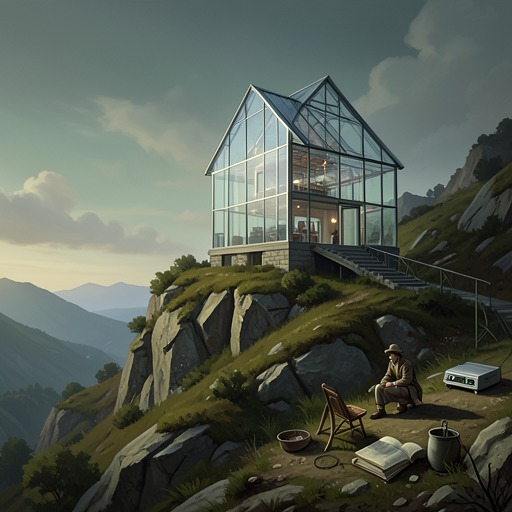
The Glass RoomLandauer House as a hospital physiotherapy gymnasium is the building’s postwar life as a place of treatment for children disabled by polio. Its broad, light-filled rooms and onyx partition become the setting for exercises and rehabilitation, while the building’s everyday usefulness conflicts with efforts to preserve it as an architectural treasure. The dispute turns the house into more than a monument: it asks whether its value lies in its history, its design, or the care taking place within it.
From private house to working gymnasium
By the time Tomáš and Zdenka work there, Landauer House serves the physiotherapy department as a children’s gymnasium. A dozen mats lie along the floor before the onyx wall, where Zdenka guides the children through leg lifts, bends, stretches, and turns. The movements are difficult and awkward; their parents will collect them after the session, leaving Tomáš and Zdenka time to talk. The house, once conceived as a residence, has become a public clinical space organized around treatment and the bodies of its young patients.
The children are polio victims, and the narrative describes the visible effects of their illness in stark terms. Tomáš, a paediatrician at the nearby children’s hospital, also knows of patients in more severe condition: Alenka, for instance, lives in an iron lung, dependent on machinery to breathe and facing a world mediated by a mirror. The hospital use of the house is thus part of a larger medical setting, but the gymnasium gives the children room to exercise together rather than appearing only as isolated patients in hospital beds. The account does not suggest that exercise erases disability; it shows the work of care unfolding amid bodily difficulty.
The Glass Room in daily use
Tomáš calls the gymnasium the Glass Room. The word he uses for room, pokoj, can also mean peace, quiet, or tranquillity, so the name carries an additional resonance: to him, the room is also a glass tranquillity. It seems detached from any particular period or style, a space of light and stillness where he can be with Zdenka after work. For Tomáš, who resists thinking in terms of past and future, its present use is immediate: a view through the window, a cigarette, and Zdenka moving through the room as she leads the children’s exercises.
The space serves more than the hospital’s scheduled therapy. Zdenka holds dance classes there after work to earn extra money, and Tomáš sometimes watches from a seat in a corner. The arrangement is irregular, but the children of Party officials attend, and the use of a state-owned building for private enterprise is quietly tolerated. The dancers’ ungainly or beautiful movements and their chatter offer Tomáš relief from the daily work of treating children crippled by disease. In this room, medical, private, and unofficial uses overlap without making the building cease to function as a place of care.
That overlap is also intimate. Because of the housing shortage, Tomáš still lives in his parents’ house, while Zdenka has a room in the nurses’ hostel, where men are not allowed in the women’s section. With no safe place to go, they make love on the floor of the Glass Room despite the possibility that a caretaker or one of Zdenka’s colleagues might come in. The gymnasium’s institutional function does not keep it sealed off from private life; the constraints of housing make the public building the place where their desire finds room.
Use against preservation
The building’s present function becomes the subject of a proposed article about its architectural importance. A visitor tells Tomáš that people want to restore Landauer House and turn it into a museum, under the attention of the State Committee for Architectural Heritage. Tomáš rejects the proposal’s premise. The building is valuable as a gymnasium, he argues, but impossible as a house and worthless as a museum. For him, a museum, like a church, memorializes something finished; the past and religion are fantasies when set against the work the building does now. His response is not simply indifference to architecture: it makes present use the measure by which the house should be valued.
A newspaper article frames the same tension differently. It presents the city as a treasury of architecture and calls the house an architectural treasure, but acknowledges that it is currently a children’s gymnasium. Its correspondent says that the younger generation’s health and care matter, while questioning whether such treatment must take place in a building of exceptional architectural importance. The argument does not deny the children treatment; it asks whether the hospital’s use is compatible with preserving the house. The disagreement is therefore over competing kinds of value, rather than a choice between caring for children and caring about architecture in the abstract.
Architecture inhabited and remembered
The newspaper’s description makes the contrast concrete. Landauer House stands in the Blackfield district, in a residential area overlooking Lužánky Park and the city centre. Its living room measures 230 square metres, with two walls of glass and a view toward Špilas. Chrome pillars, a partition of pure onyx slabs, and cream linoleum remain in more or less original condition, although the original plate-glass windows were destroyed by a wartime bomb blast and replaced with smaller panes. The house’s modernist openness and carefully specified materials survive inside its changed institutional role.
The building’s history is also filtered through competing recollections. The heritage committee member identifies the Landauers as a prominent capitalist family and says that Rainer Abt designed the house in the late 1920s. The former caretaker Josef Laník, now on the local District Committee, remembers the family’s life as indecently luxurious, but also recalls maintaining the building as bombs fell and defending it with his sister against the Nazis during liberation. He says they eventually handed it over intact to the Soviet forces and hopes it will open to the public, allowing ordinary people to enjoy what had once been the privilege of a few. His account lends the preservation campaign a social claim of its own: the house might become publicly accessible, not merely restored for admiration.
A building defined by competing presents
The gymnasium’s significance comes from the collision of an architectural ideal with the daily requirements of treatment. Tomáš sees a living institution where the heritage advocate sees a house in danger of losing its proper historical meaning; the newspaper makes the children’s health and the building’s rarity bear against one another. Yet the room’s uses refuse a clean division between monument and utility. Mats are laid before the onyx wall, children exercise beneath the glass, dancers use the floor after work, and Tomáš and Zdenka claim a private moment there because the city offers them nowhere else.
Tomáš’s belief in a continuous present sharpens this conflict. He resists memorializing the building as a finished past, while the campaign to restore it depends on recognizing its architectural history. The gymnasium makes that disagreement material: Landauer House is not only something to remember or preserve but somewhere people are presently being treated. Its changing purpose neither cancels its design nor leaves it untouched; the house’s value is contested precisely because its striking spaces continue to be lived in and put to use.